FRAMEWORKS

Framework-aware reporting support

CIIS does not replace professional judgement or framework expertise. It helps organise outcomes information so statements can be interpreted against selected reporting lenses, while keeping evidence quality, confidence, and limitations visible.

Teams often need the same underlying evidence to speak to different reporting expectations. CIIS is being developed to support framework-aware views on structured impact data — not universal automation of every framework pathway, and not certification.

Boundary

We do not claim official certification or alignment with framework owners. Framework labels help structure interpretation; statements still need evidence, measures, and explicit limits. Your organisation remains responsible for meeting funder, regulator, or legal requirements.

Why Frameworks Matter

Impact measurement happens within frameworks. Different funders, stakeholders, and reporting requirements use different frameworks:

  • International funders often require SDG alignment
  • Social investors want SROI calculations
  • Local government may use wellbeing frameworks
  • Boards need governance metrics
  • Evaluators work with Theory of Change

This creates a problem: organisations end up collecting the same data multiple times, in different formats, for different audiences. It's inefficient and increases the risk of inconsistencies.

What CIIS aims to reduce

The problem is familiar: the same evidence re-keyed for different tables, or framework narratives that drift from what the data can actually support. CIIS focuses on structured outcomes, measures, and evidence support, then applies reporting lenses where the implementation and pilot scope support them.

In practice, that can mean:

  • CSV-first bulk paths for spreadsheet-style data, with other import routes scoped by deployment (see current status).
  • One structured datasetinterpreted through supported lenses where methodology is agreed — not "automatic" compliance with every framework rule set.
  • Evidence support and limitations surfaced before outputs go to boards, funders, or commissioners.
Same data, multiple lenses
Diagram: Unified Impact Score at centre with ten framework lenses on one dataset — SDG, SROI, TBL, DEI, Wellbeing, Resilience, Governance, AARRR, CEMP, Theory of Change
Conceptual illustration using CIIS brand colours (Impact Intelligence Lab). Framework names are descriptive, not certification marks.

Supported Framework Lenses

The product supports multiple framework lenses on structured data; which lenses are active, and how deep they go, depends on pilot and release. The list below is descriptive — not a promise that every indicator for every framework is implemented for every deployment.

International

SDGs lens in CIIS (Collaborative Impact Intelligence System)

SDGs

Sustainable Development Goals

SDG language can situate work against recognised global goals. CIIS should only surface SDG-aligned statements where underlying project data and evidence support that interpretation.

Use case: International reporting narratives where evidence supports goal mapping

Financial

SROI lens in CIIS (Collaborative Impact Intelligence System)

SROI

Social Return on Investment

Calculate and present social return on investment indicators for your programs — including ratio-style summaries and stakeholder valuations where the report type and evidence readiness support that framing.

Use case: Social investors, financial impact measurement

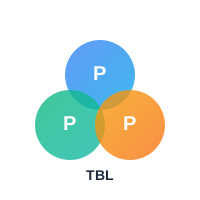
TBL lens in CIIS (Collaborative Impact Intelligence System)

TBL

Triple Bottom Line

Assess social, environmental, and economic impacts in a unified view. People, Planet, Profit breakdown.

Use case: Sustainable business reporting, comprehensive impact assessment

Community

DEI lens in CIIS (Collaborative Impact Intelligence System)

DEI

Diversity, Equity, Inclusion

Measure and report on diversity, equity, and inclusion outcomes across programs and organisations.

Use case: Organisational DEI reporting, inclusive impact measurement

Wellbeing lens in CIIS (Collaborative Impact Intelligence System)

Wellbeing

Wellbeing Frameworks

Measure and report on wellbeing outcomes using established frameworks.

Use case: Local government, community health, quality of life measurement

Resilience lens in CIIS (Collaborative Impact Intelligence System)

Resilience

Resilience Indicators

Track community and organisational resilience indicators over time.

Use case: Community development, disaster preparedness, adaptive capacity

Governance lens in CIIS (Collaborative Impact Intelligence System)

Governance

Governance Metrics

Monitor governance quality, transparency, and accountability measures.

Use case: Board reporting, organisational governance, accountability frameworks

Organisational

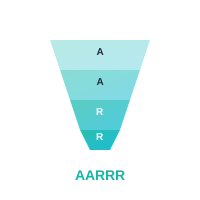
AARRR lens in CIIS (Collaborative Impact Intelligence System)

AARRR

AARRR Funnel Analysis

Conversion funnel analysis for impact programs. Track Acquisition, Activation, Retention, Referral, and Revenue metrics.

Use case: Program optimisation, growth metrics, conversion tracking

CEMP lens in CIIS (Collaborative Impact Intelligence System)

CEMP

Community Engagement & Media Platform
Measure community engagement and media platform impact. Track reach, engagement, and community participation.

Use case: Community engagement programs, media impact, digital outreach

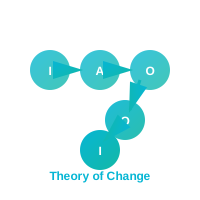
Theory of Change lens in CIIS (Collaborative Impact Intelligence System)

Theory of Change

Theory of Change

Map your impact data to your organisation's theory of change. Link activities to outcomes with real data.

Use case: Evaluation, strategic planning, outcome mapping

Unified Impact Score lens in CIIS (Collaborative Impact Intelligence System)

Unified Impact Score

Unified Impact Score (UIS)

A composite view that combines weighted framework perspectives where the implementation supports it — an executive lens, not a substitute for framework expertise or legal sign-off.

Use case: Executive overview when methodology and weights are understood in context

Unified Impact Score (UIS)

Where enabled, UIS summarises weighted perspectives for executive-style views. It does not remove the need to read methodology, weights, and evidence strength — and it is not a substitute for framework-specific assurance when your context requires it.

Methodology

CIIS uses a structured approach to impact measurement:

  1. 1.Unified Metrics: All impact data is stored using a standardised structure that captures what happened, who it affected, and what changed.
  2. 2.Framework Mapping: CIIS maps unified metrics to framework-specific indicators and calculations.
  3. 3.Evidence Trails: Every calculation and conclusion links back to source data, so you can explain how results were reached.
  4. 4.Confidence Signals: CIIS indicates where evidence is strong and where it's weaker, helping you make informed decisions about data quality.

The goal is credible reporting: statements inspectable against evidence, with framework language used responsibly — not maximum framework coverage for its own sake.

Framework questions for your context?

Bring your reporting obligations and evidence reality to a guided conversation. We will separate live capability from pilot-scoped work.

Request a guided pilot conversation